Enneagram core motivations
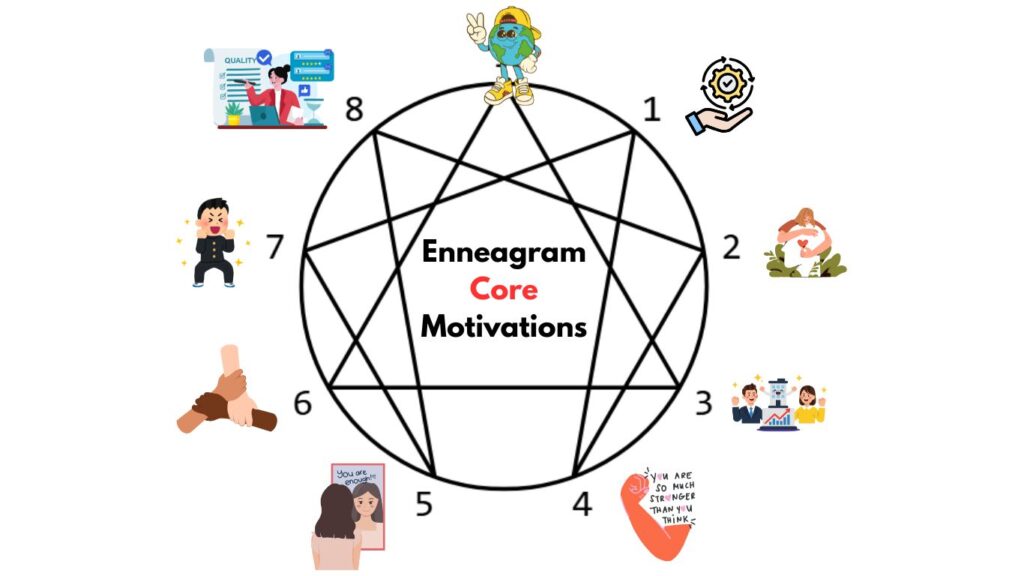
Every person carries a quiet inner force that shapes how they think, feel, and respond to life. In the Enneagram system, we call this your core motivation. It’s not about your habits or surface behaviors, it’s about the emotional need that sits at the heart of your personality.
This motivation is usually subtle, often unconscious, and formed early in life. But it influences nearly everything: how you act, what you avoid, and what gives your life a sense of meaning.
In this guide, we’ll explore what core motivations are, how they work, how they differ from similar ideas, and how to recognize your own.
Quick overview of the core motivations for all 9 types
Here is a simple, gentle summary of what each type is internally driven toward.
(We only look at motivations — no fears.)
Quick chart (types and core motivations)
| Type | Name | Core motivation |
|---|---|---|
| Type 1 | The Reformer | A steady drive to live with integrity and do what feels right and responsible. |
| Type 2 | The Helper | A deep need to feel loved, appreciated, and emotionally connected to others. |
| Type 3 | The Achiever | A strong desire to feel valuable, successful, and recognized for their efforts. |
| Type 4 | The Individualist | A longing to express their authentic inner world and feel emotionally significant and understood. |
| Type 5 | The Investigator | A wish to feel capable, knowledgeable, and self-sufficient, with enough inner resources to manage life. |
| Type 6 | The Loyalist | A need to feel secure, supported, and grounded in something stable. |
| Type 7 | The Enthusiast | A desire to experience joy, freedom, variety, and exciting possibilities. |
| Type 8 | The Challenger | A drive to feel strong, autonomous, and fully in control of their life and boundaries. |
| Type 9 | The Peacemaker | A longing for inner peace, harmony, and steady connection with others and with themselves. |
Discover your core motivation with our ennegram
What are Enneagram core motivations (and what they’re not)
Core motivations are the quiet emotional needs that sit underneath your personality.
They are not preferences, hobbies, or surface behaviors. They are deeper almost like an inner compass that pulls you in a certain direction.
Core motivation is not the same as life goals or values
A core motivation is not the same as:
- your habits
- your ambitions
- your daily preferences
- your strengths
- or your personality quirks
Two people can behave the same way but be driven by completely different motivations.
Example:
Two people may work hard and achieve a lot.
One does it because they want to feel valuable (Type 3).
The other does it because they want stability and predictability (Type 6).
Same behavior — completely different inner world.
This is why motivation, not behavior, determines your Enneagram type.
Core motivations develop early and often become subconscious
Most people form their core motivation in childhood, not because something dramatic happened, but because their heart found a specific emotional direction that felt safe and familiar.
Over time, this direction becomes so natural that:
- you rarely question it
- you rely on it without thinking
- you feel “off” when you drift away from it
- you return to it when overwhelmed
It’s not dysfunctional — it’s simply a deep pattern of belonging and comfort.
How core motivations guide your automatic patterns
Your core motivation influences:
- what brings you comfort
- what helps you feel emotionally “right”
- what you seek in relationships
- what you avoid
- how you respond under stress
- and how you try to find balance again
You don’t choose your core motivation. It simply is steady, familiar, and deeply human.
The 9 Enneagram core motivations explained in depth
Here you’ll find a warm, clear exploration of what truly drives each type.
For each type, you’ll see:
- the inner motivation
- what the type naturally seeks
- what unsettles them
- their typical “automatic pattern”
- their healthy and less healthy expressions
Type 1: the reformer — integrity and inner alignment
Core motivation: To live in alignment with what feels right, good, and responsible.
- Seeks: order, consistency, honesty, self-respect
- Feels unsettled when: things feel unfair, sloppy, or out of integrity
- Automatic pattern: trying to improve themselves or their environment
- Healthy expression: calm discipline, fairness, reliability
- Less healthy expression: inner pressure, self-criticism, rigidity
Type 2: the helper — love, connection, and appreciation
Core motivation: To feel loved and emotionally valued by others.
- Seeks: closeness, warmth, appreciation
- Feels unsettled when: they sense distance or emotional disconnection
- Automatic pattern: offering support or care to be close to others
- Healthy expression: generosity, presence, empathy
- Less healthy expression: overgiving, people-pleasing, neglecting their own needs
Type 3: the achiever — value, success, and admiration
Core motivation: To feel valuable, competent, and successful.
- Seeks: achievement, recognition, progress
- Feels unsettled when: they sense they’re falling short
- Automatic pattern: focusing on goals, efficiency, and measurable success
- Healthy expression: inspiration, productivity, encouragement
- Less healthy expression: burnout, image-management, emotional disconnection
Type 4: the individualist — authenticity and emotional meaning
Core motivation: To express their true identity and feel emotionally significant.
- Seeks: depth, meaning, authenticity
- Feels unsettled when: emotions feel numbed or identities feel unclear
- Automatic pattern: looking inward and comparing themselves
- Healthy expression: creativity, emotional honesty, sensitivity
- Less healthy expression: withdrawal, longing, focus on what’s missing
Type 5: the investigator — knowledge and inner stability
Core motivation: To feel capable, informed, and self-sufficient.
- Seeks: clarity, space, understanding
- Feels unsettled when: demands feel too intense or resources feel low
- Automatic pattern: withdrawing to analyze or recharge
- Healthy expression: insight, stability, thoughtful observation
- Less healthy expression: emotional distance, overthinking, isolation
Type 6: the loyalist — groundedness and emotional safety
Core motivation: To feel secure, supported, and prepared.
- Seeks: consistency, reassurance, predictability
- Feels unsettled when: things feel uncertain or unsteady
- Automatic pattern: scanning for risks or seeking guidance
- Healthy expression: loyalty, courage, preparedness
- Less healthy expression: worry, self-doubt, second-guessing
Type 7: the enthusiast — joy, freedom, and possibility
Core motivation: To experience joy, freedom, and positive opportunities.
- Seeks: excitement, stimulation, pleasant experiences
- Feels unsettled when: life feels heavy, limited, or emotionally painful
- Automatic pattern: looking for the next uplifting thing
- Healthy expression: optimism, resilience, creativity
- Less healthy expression: impulsiveness, avoidance, overstimulation
Type 8: the challenger — strength, autonomy, and self-protection
Core motivation: To feel strong, independent, and in control of their life.
- Seeks: honesty, power, directness
- Feels unsettled when: they sense vulnerability or dependence
- Automatic pattern: taking charge to feel protected
- Healthy expression: leadership, protection, straightforwardness
- Less healthy expression: intensity, aggression, defensiveness
Type 9: the peacemaker — inner peace and steady connection
Core motivation: To experience peace, stability, and harmonious connection.
- Seeks: comfort, ease, unity
- Feels unsettled when: conflict or tension disrupts the atmosphere
- Automatic pattern: blending in or minimizing themselves
- Healthy expression: patience, acceptance, calm presence
- Less healthy expression: numbing, passivity, avoidance
How to use core motivations to find your Enneagram type
Self-typing becomes clearer when you look at what feels emotionally essential, rather than focusing on behavior.
Step 1: Notice what feels emotionally “necessary” for your well-being
Ask yourself gently:
“What do I feel I need, deep down, to be okay?” Connection? Peace? Strength? Success? Certainty? Authenticity? The motivation that feels essential is usually your type.
Step 2: Compare similar motivations between types
Sometimes motivations sound similar at first glance. Small differences matter.
Example distinctions:
- 2 vs 9:
2 seeks emotional closeness;
9 seeks peaceful connection. - 3 vs 1:
3 seeks success;
1 seeks inner alignment with their values. - 6 vs 9:
6 seeks emotional stability;
9 seeks internal calm. - 4 vs 5:
4 seeks emotional depth;
5 seeks emotional spaciousness.
These subtle shifts help you find your true type.
Step 3: Look at your automatic coping patterns
Your core motivation reveals itself most clearly when:
- you’re stressed
- you’re tired
- you’re overwhelmed
- you’re reacting quickly
Automatic patterns are the “breadcrumbs” that lead you to your type.
Applying core motivations in real life
Understanding your core motivation makes your emotional world softer and clearer.
In relationships
Core motivations help you understand:
- what you need to feel close
- what helps you feel safe
- why you react the way you do in conflict
- how to communicate with more compassion
It also helps you understand your partner’s emotional world.
At work
Knowledge of core motivations supports:
- healthier boundaries
- more resilience
- clearer communication
- recognising team dynamics
- better leadership and collaboration
For personal growth
When you understand your core motivation:
- you stop fighting your patterns
- you begin working with them
- you recognise when you’re acting from need
- and when you’re acting from awareness
Growth becomes gentler.
Common misconceptions about Enneagram core motivations
“Everyone wants love or peace—how does this define my type?”
It’s true that we all value love, peace, or success. But your core motivation is the one that feels absolutely essential. It’s not just nice to have. It’s what your system clings to when things feel uncertain.
“Can I have more than one core motivation?”
You may relate to several types, especially in different situations. But there is usually one core motivation that drives you most consistently. That’s your type.
“Can my motivation change over time?”
Your behavior might change. Your life might shift. But your core motivation tends to stay steady. What evolves is your relationship to it, it becomes more conscious, more flexible, and more free.
“Are tests enough to find my core motivation?”
Tests can help, but they measure behavior more than motivation. They’re a starting point, not a final answer. The best way to find your type is through self-observation, curiosity, and sometimes reflection with someone trained in the Enneagram.
“Is one motivation better than another?”
Not at all. Each motivation carries beauty and difficulty. Each one can express itself in healthy, balanced ways or in fearful, reactive ways. The goal is not to change your core motivation, but to live it with more awareness and grace.